Aperçu
L’essai LAKANA (« Évaluation à grande échelle des principales activités de promotion de la santé de deux nouveaux schémas thérapeutiques de distribution massive d’azithromycine », dérivé du mot bambara signifiant « protéger ») était une importante étude randomisée par grappes, en double aveugle, contrôlée par placebo, à trois bras, menée dans l’ouest du Mali.
CVD-Mali est fier du travail accompli par ses équipes LAKANA et des excellentes relations qu’elles ont nouées dans toutes les communautés participant au projet.
La vidéo ci-dessus est un bref témoignage de certains des défis et des succès qu’ils ont rencontrés.
Il s’agit également d’un remerciement sincère à tous les membres des équipes LAKANA de CVD-Mali pour leur dévouement et leur travail acharné.
Détails
But
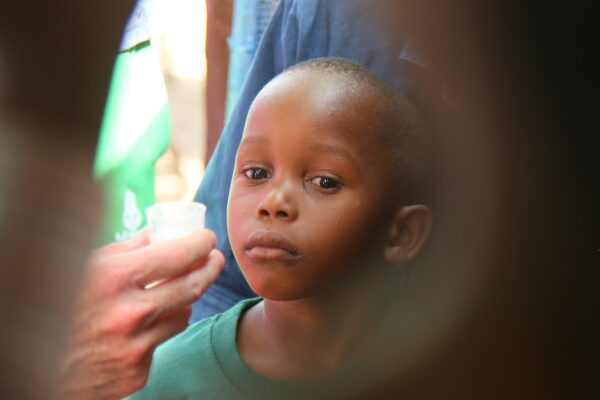
L’essai visait à évaluer si l’administration massive (MDA) d’azithromycine, un antibiotique fiable, peu coûteux et à large spectre recommandé par l’Organisation mondiale de la santé, pouvait réduire les taux de mortalité élevés chez les nourrissons âgés de 1 à 11 mois dans les communautés rurales et périurbaines du Mali. Il a comparé trois groupes : un groupe placebo (témoin), un groupe recevant deux doses par an et un groupe recevant quatre doses par an.
Conception et portée
Environ 50 000 à 60 000 nourrissons issus de quelque 1 151 villages des régions de Kayes, Kita et Koulikoro ont participé à cet essai de 24 mois, qui comprenait huit visites d’administration de masse de médicaments (AMM), ainsi qu’une visite de clôture. Les villages ont été randomisés selon un ratio de 3:2:4 pour le contrôle, l’administration trimestrielle et l’administration semestrielle d’azithromycine, respectivement.
Objectifs principaux et secondaires
L’objectif principal était de déterminer si l’administration semestrielle ou trimestrielle d’azithromycine dans le cadre d’une AMM réduisait la mortalité infantile et si quatre doses annuelles étaient plus efficaces que deux.
Les objectifs secondaires comprenaient l’évaluation des effets sur la résistance aux antimicrobiens (RAM) chez les groupes d’âge traités et non traités, la morbidité infantile et les effets nutritionnels, les mécanismes d’action de l’azithromycine, ainsi que la faisabilité, la sécurité et les considérations économiques liés à la distribution.
Chronologie et applications futures
La collecte des données s’est achevée à la mi-janvier 2025, et les premiers résultats devraient être publiés en 2025/26. L’essai a été conçu pour éclairer la politique relative à la possible expansion de l’AMM à l’azithromycine en tant qu’intervention nationale de santé publique au Mali.
Mise en œuvre et supervision
L’essai a été mené par un consortium comprenant le Centre de développement de vaccins du Mali (CVD-Mali), l’université de Tampere (Finlande), Duke-NUS (Singapour), l’University College London (Royaume-Uni) et Tro Da Ltd (Royaume-Uni). Il a été financé par la Fondation Bill & Melinda Gates, et les médicaments ont été donnés par Pfizer. La supervision a été assurée par un comité indépendant de surveillance des données et de la sécurité (DSMB), un comité d’éthique national et le ministère de la Santé du Mali, garantissant le respect des bonnes pratiques cliniques.